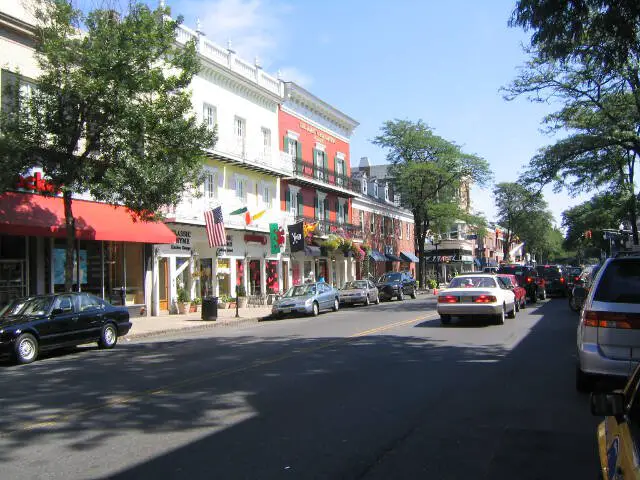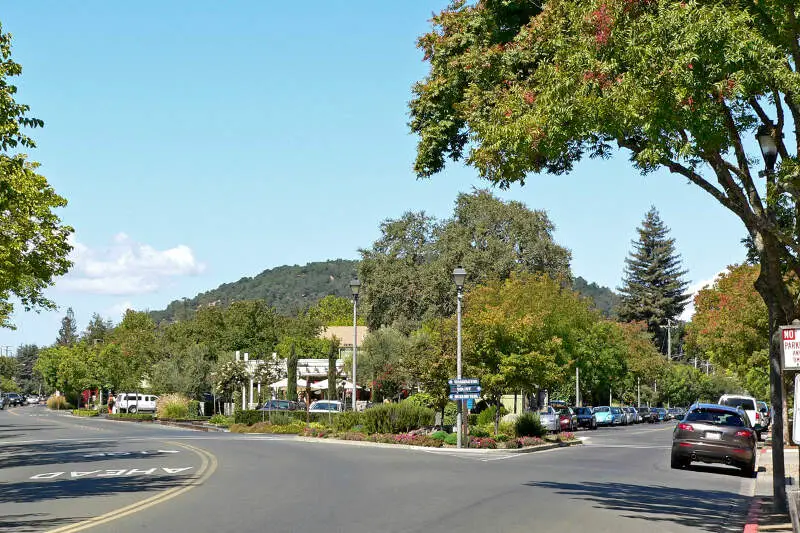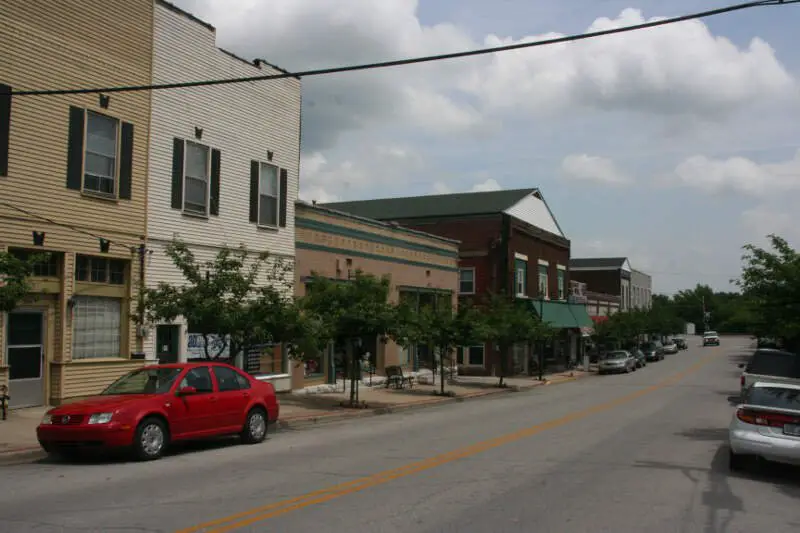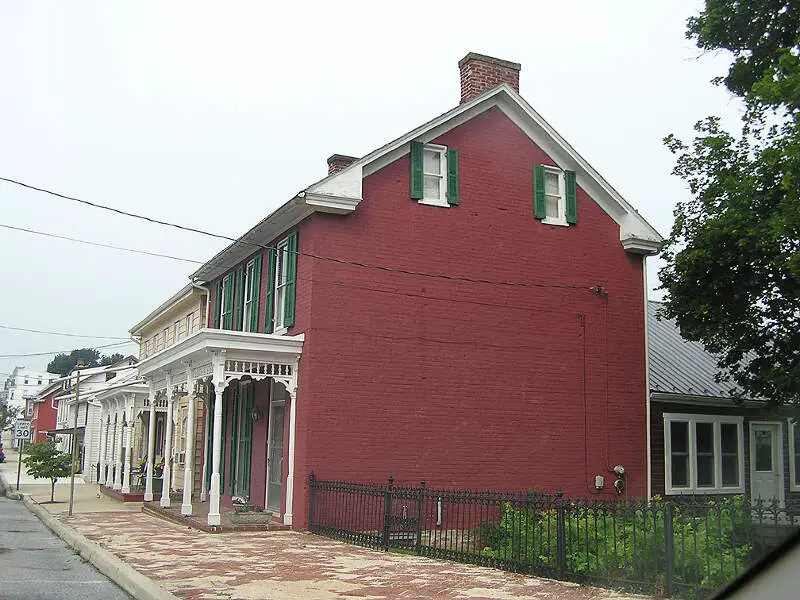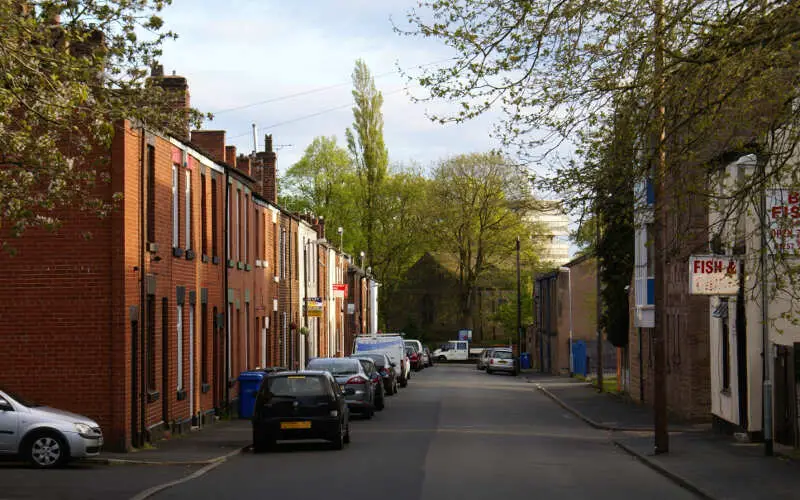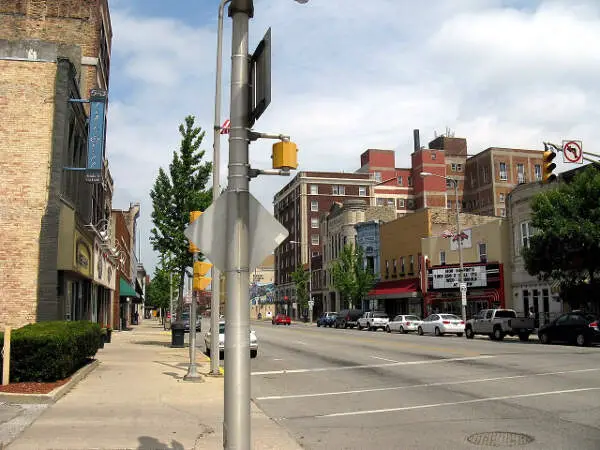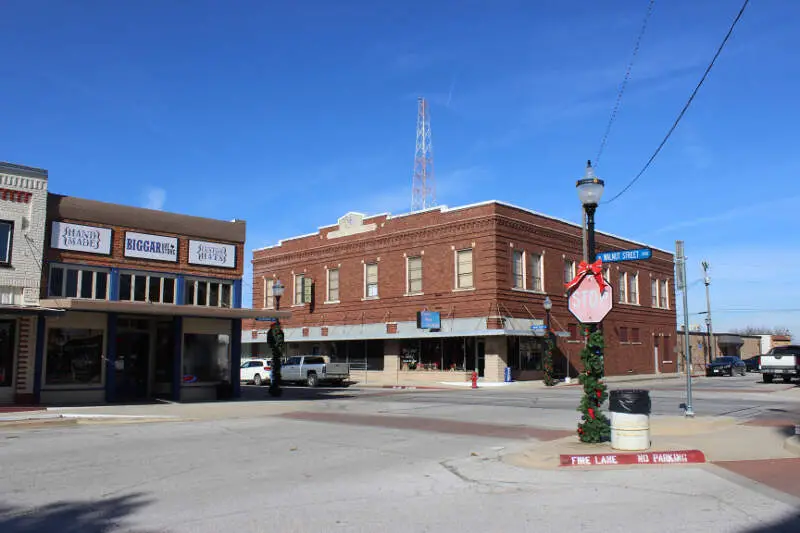
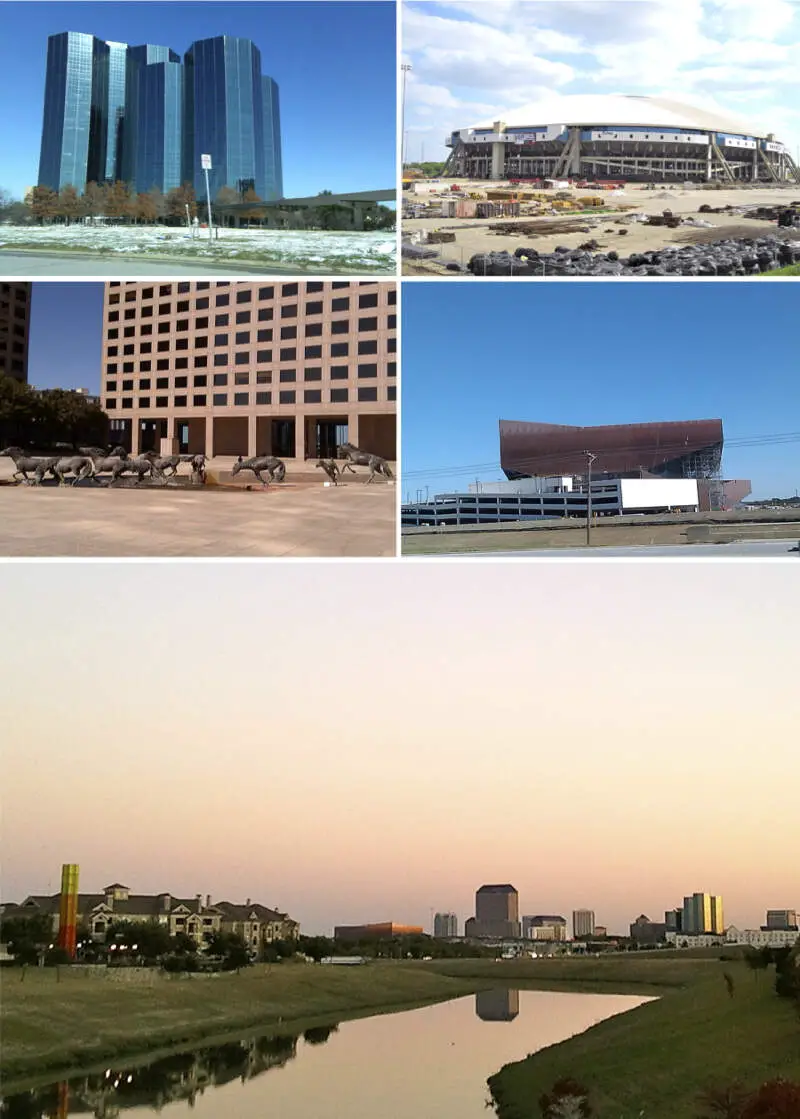
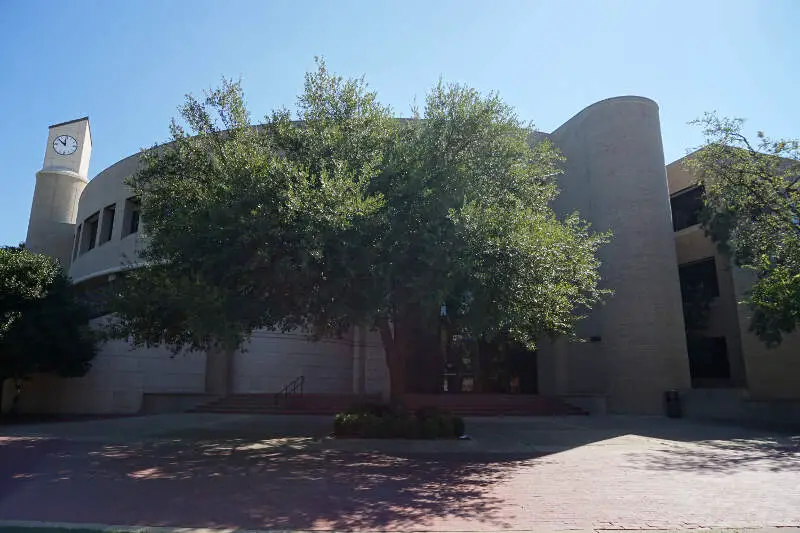
Irving vs. Plano in photos
A side-by-side look at each city.

Cost of living
Irving is the cheaper city overall — 16% higher in Plano than its rival. Index baseline: 100 = national average.
| Living expense | Irving | Plano | US average |
|---|---|---|---|
| Overall | 101 | 120 | 100 |
| Services | 101 | 97 | 100 |
| Groceries | 98 | 99 | 100 |
| Health | 116 | 176 | 100 |
| Housing | 101 | 101 | 100 |
| Transportation | 105 | 100 | 100 |
| Utilities | 97 | 105 | 100 |
Lower index = cheaper. 100 = U.S. national average. Bar inside each cell scales relative to the highest value in the table.
Sources: HomeSnacks Cost of Living indices, normalized so 100 = U.S. national average. Drill in: Irving cost of living, Plano cost of living, or the cheapest cities in America.
Housing breakdown
Home prices are higher in Plano. Compare absolute price and price-to-income — a $500k home in a $100k-income city is very different from one in a $50k-income city.
| Metric | Irving | Plano | United States |
|---|---|---|---|
| Median Home Value | $341,503 | $498,989 | $332,700 |
| Median Rent | $1,619 | $1,841 | $1,413 |
| Median Income | $81,830 | $112,253 | $80,734 |
| Home Value To Income | 4.2x | 4.4x | 4.1x |
| Rent To Monthly Income | 0.24x | 0.2x | 0.21x |
Source: U.S. Census Bureau ACS 2020-2024. See also states with the highest rent in America.
Crime
Plano is the safer city — total crime rate of 1,618 per 100k people vs 2,474 for Irving. US average: 2,119.
| Crime (per 100k) | Irving | Plano | US average |
|---|---|---|---|
| Total crime | 2,474 | 1,618 | 2,119 |
| Murder | 7 | 1 | 5 |
| Robbery | 57 | 27 | 61 |
| Aggravated Assault | 157 | 91 | 256 |
| Violent Crime | 275 | 152 | 359 |
| Burglary | 250 | 161 | 229 |
| Larceny | 1,522 | 1,163 | 1,272 |
| Car Theft | 427 | 142 | 259 |
| Property Crime | 2,199 | 1,466 | 1,760 |
Lower = safer. Bar inside each cell scales relative to the highest crime rate in the table.
Source: FBI Uniform Crime Reporting (2024). All rates are per 100,000 people. City pages: Irving crime, Plano crime. See also: safest cities in America.
Diversity
Irving is more racially diverse — lower HHI (closer to 0) means a more even mix across groups.
| Group | Irving | Plano | United States |
|---|---|---|---|
| White | 17.8% | 46.6% | 57.4% |
| African American | 12.7% | 8.7% | 11.9% |
| American Indian | 0.1% | 0.2% | 0.5% |
| Asian | 23.1% | 23.6% | 5.9% |
| Hawaiian | 0.0% | 0.0% | 0.2% |
| Other | 0.5% | 0.7% | 0.6% |
| Two Or More | 2.4% | 3.5% | 4.3% |
| Hispanic | 43.4% | 16.7% | 19.3% |
Source: U.S. Census ACS 2020-2024. Lower HHI = more even racial mix. See also: most diverse cities in America.
SnackAbility — overall quality of life
Plano scores higher overall — 8.5/10 vs 6/10. SnackAbility is our 1–10 quality-of-life score; the median U.S. city scores a 7.
Scores are 0–10; both bars share the same scale.
SnackAbility is a HomeSnacks proprietary 1–10 score blending jobs, housing, education, commute, amenities, affordability, crime, and diversity. Median U.S. city ≈ 7. Data: Census, BLS, FBI. See also: best places to live in America.
Getting around: Irving vs. Plano
How each city handles commuting, transit, walkability, and car culture — the day-to-day reality that shapes where you'd actually want to live.
Both Irving and Plano sit inside the DART network, but Irving has a real edge for transit commuters. The Orange and Blue lines run through Las Colinas and connect to downtown Dallas and DFW Airport without touching a freeway, which is rare in the suburbs. If you work near the Urban Center or need to fly often, that access matters.
Plano is served by the Red Line, with stops at Downtown Plano, Parker Road, and other northern stations. The city is larger and more spread out, though, so most residents still default to a car for daily errands.
On the highway side, Irving sits at the intersection of I-635, SH-114, and I-35E, which sounds convenient until rush hour turns the mixmaster into a parking lot. Plano's main arteries, US-75 and the Sam Rayburn Tollway, carry their own heavy load heading south toward Dallas. Neither city will feel walkable outside of a few pockets.
Jobs and careers in Irving vs. Plano
The local job market, dominant industries, and which city to choose based on your career.
If your career is in corporate America, both cities deliver, but they attract different industries. Irving's Las Colinas district is one of the densest office corridors in North Texas, home to headquarters and major operations for Celanese, Fluor, Christus Health, Nokia, and 7-Eleven, among others. The proximity to DFW Airport makes it a natural fit for companies with heavy travel needs.
Median household income in Irving sits at $81,830, covering a wide mix of white-collar and service-sector workers.
Plano leans more heavily toward corporate headquarters, and the paycheck reflects it: median household income reaches $112,253. Toyota's North American headquarters anchors Legacy West, joined by JPMorgan Chase, Liberty Mutual, Keurig Dr Pepper, and Ericsson. Frito-Lay's campus has been a Plano fixture for decades.
If you're targeting Fortune 500 roles or financial services, Plano's Legacy corridor is one of the more concentrated job markets in the Metroplex.
Weather and climate
What to expect day-to-day — sun, fog, heat, rain, and the seasonal extremes that shape the lifestyle.
Irving and Plano have nearly identical climates. Both sit in the DFW Metroplex, separated by about 20 miles and no meaningful elevation change. Summers are long and punishing, with July and August routinely pushing into the high 90s and crossing 100°F during heat waves.
You'll run your air conditioning from May through October. Spring and fall offer genuinely pleasant stretches, and winters are mostly mild, though both cities can get caught in the ice storms that occasionally paralyze the region, as the February 2021 freeze made clear.
Tornado risk is real in both cities. The DFW area sits in the southern edge of Tornado Alley, and severe weather season runs March through May, so you should know where your shelter is. Neither city has a weather advantage worth factoring into a relocation decision; pick based on everything else.
Culture, nightlife, and entertainment
Food, music, neighborhoods, and the city vibe that gives each place its personality.
Irving has more cultural depth than its reputation suggests, anchored by the Toyota Music Factory, a mixed-use entertainment district that hosts national touring acts at an 8,000-capacity amphitheater alongside restaurants and an Alamo Drafthouse. The city's population is heavily Latino, with a large South Asian community around Las Colinas, and the dining scene reflects that range: Tex-Mex taquerias along Story Road, Indian restaurants and grocery stores concentrated near Valley Ranch. The Mustangs of Las Colinas sculpture is one of the more memorable public art pieces in the region.
Plano skews more toward polished retail and upscale dining. Legacy West and the adjoining Shops at Legacy draw crowds to restaurants like Ida Claire and Haywire, alongside the communal food hall at Legacy Hall. Downtown Plano has a smaller Arts District with galleries and live music venues.
Nightlife is moderate in both cities. Dallas proper is never far when you want a late night out.
Outdoor activities and day trips
Parks, beaches, hikes, and the weekend escapes that define life outside the city limits.
Irving's best outdoor asset is the Campion Trail, a paved multi-use path that runs roughly 12 miles along the Elm Fork of the Trinity River. It connects to a broader trail network and draws cyclists and runners looking for a flat, shaded route without many stoplights. Lake Carolyn in the Las Colinas Urban Center adds a waterfront option for walking or kayaking, though it's a small, managed lake rather than a wild recreation area.
Plano offers more variety. Arbor Hills Nature Preserve on the city's west side has unpaved trails through wooded terrain, which is unusual for a flat suburban city, and draws hikers and trail runners year-round. Oak Point Park and Nature Preserve adds another large green space with creek access and disc golf.
If you're willing to drive 30-40 minutes, Lake Lavon and Lake Ray Hubbard both offer fishing, boating, and camping, and Irving residents have equal access to both. Plano's trail and preserve system gives it a slight edge for dedicated outdoor enthusiasts.
Bottom line: which city is right for you?
Based on the head-to-head data above, here's the short version — pick the city that lines up with what you actually care about.
Choose Irving if you prioritize…
- a lower cost of living (cheaper groceries, services, and day-to-day expenses).
- a more racially diverse community (lower HHI on Census data).
Choose Plano if you prioritize…
- lower crime — a safer place to live, work, and raise a family.
- more affordable housing relative to Irving.
- a higher overall SnackAbility quality-of-life score.
Methodology: winners are picked from public data — U.S. Census Bureau ACS (income, home value, rent, race/HHI), FBI Uniform Crime Reporting (crime rates per 100k), and HomeSnacks' proprietary SnackAbility quality-of-life score, which blends Bureau of Labor Statistics data with the above.
Other comparisons
Still weighing your options? See how these two cities stack up against other places we've compared head-to-head.