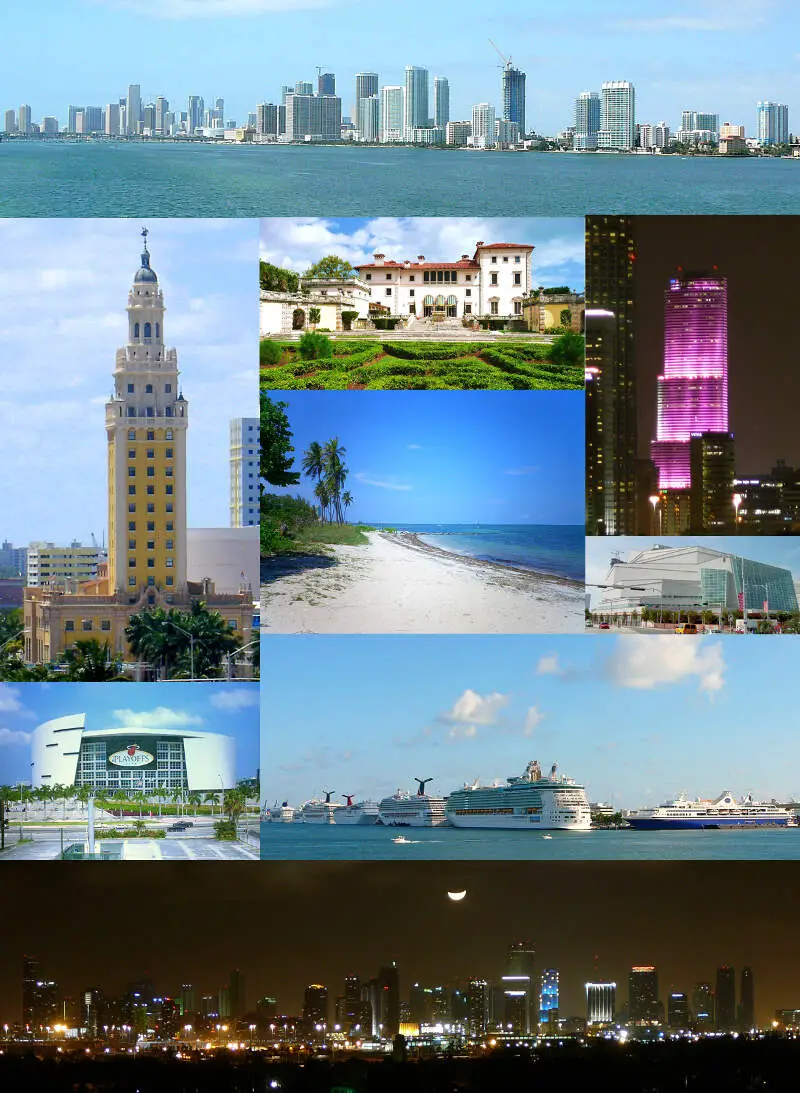
Los Angeles vs. Miami in photos
A side-by-side look at each city.





Cost of living
Miami is the cheaper city overall — 37% higher in Los Angeles than its rival. Index baseline: 100 = national average.
| Living expense | Los Angeles | Miami | US average |
|---|---|---|---|
| Overall | 179 | 131 | 100 |
| Services | 117 | 106 | 100 |
| Groceries | 123 | 110 | 100 |
| Health | 309 | 169 | 100 |
| Housing | 128 | 108 | 100 |
| Transportation | 128 | 121 | 100 |
| Utilities | 134 | 120 | 100 |
Lower index = cheaper. 100 = U.S. national average. Bar inside each cell scales relative to the highest value in the table.
Sources: HomeSnacks Cost of Living indices, normalized so 100 = U.S. national average. Drill in: Los Angeles cost of living, Miami cost of living, or the cheapest cities in America.
Housing breakdown
Home prices are higher in Los Angeles. Compare absolute price and price-to-income — a $500k home in a $100k-income city is very different from one in a $50k-income city.
| Metric | Los Angeles | Miami | United States |
|---|---|---|---|
| Median Home Value | $952,183 | $579,563 | $332,700 |
| Median Rent | $1,933 | $1,758 | $1,413 |
| Median Income | $81,939 | $62,462 | $80,734 |
| Home Value To Income | 11.6x | 9.3x | 4.1x |
| Rent To Monthly Income | 0.28x | 0.34x | 0.21x |
Source: U.S. Census Bureau ACS 2020-2024. See also states with the highest rent in America.
Crime
Los Angeles is the safer city — total crime rate of 2,212 per 100k people vs 3,468 for Miami. US average: 2,119.
| Crime (per 100k) | Los Angeles | Miami | US average |
|---|---|---|---|
| Total crime | 2,212 | 3,468 | 2,119 |
| Murder | 7 | 6 | 5 |
| Robbery | 210 | 95 | 61 |
| Aggravated Assault | 471 | 348 | 256 |
| Violent Crime | 728 | 473 | 359 |
| Burglary | 373 | 294 | 229 |
| Larceny | 852 | 2,290 | 1,272 |
| Car Theft | 260 | 410 | 259 |
| Property Crime | 1,484 | 2,995 | 1,760 |
Lower = safer. Bar inside each cell scales relative to the highest crime rate in the table.
Source: FBI Uniform Crime Reporting (2024). All rates are per 100,000 people. City pages: Los Angeles crime, Miami crime. See also: safest cities in America.
Diversity
Los Angeles is more racially diverse — lower HHI (closer to 0) means a more even mix across groups.
| Group | Los Angeles | Miami | United States |
|---|---|---|---|
| White | 28.1% | 12.1% | 57.4% |
| African American | 8.1% | 11.9% | 11.9% |
| American Indian | 0.1% | 0.1% | 0.5% |
| Asian | 11.9% | 1.6% | 5.9% |
| Hawaiian | 0.1% | 0.0% | 0.2% |
| Other | 0.7% | 0.6% | 0.6% |
| Two Or More | 3.8% | 2.2% | 4.3% |
| Hispanic | 47.2% | 71.5% | 19.3% |
Source: U.S. Census ACS 2020-2024. Lower HHI = more even racial mix. See also: most diverse cities in America.
SnackAbility — overall quality of life
Los Angeles scores higher overall — 6/10 vs 5/10. SnackAbility is our 1–10 quality-of-life score; the median U.S. city scores a 7.
Scores are 0–10; both bars share the same scale.
SnackAbility is a HomeSnacks proprietary 1–10 score blending jobs, housing, education, commute, amenities, affordability, crime, and diversity. Median U.S. city ≈ 7. Data: Census, BLS, FBI. See also: best places to live in America.
Getting around: Los Angeles vs. Miami
How each city handles commuting, transit, walkability, and car culture — the day-to-day reality that shapes where you'd actually want to live.
Both Los Angeles and Miami are built around the car, so if you're hoping to ditch your keys, neither city makes it easy. In LA, the Metro Rail network has grown over the years — the B Line (Red) and A Line (Blue) are worth using if you live near a station — but most residents still deal with gridlock on the 405, 101, and I-10. Expect a frustrating commute if you cross the basin regularly.
Miami's Metrorail and the free Metromover loop work reasonably well for the downtown-to-Coral Gables corridor. Tri-Rail connects to Fort Lauderdale and West Palm Beach, but Brickell Avenue and I-95 can be just as punishing as anything LA throws at you.
Ride-share costs add up in both cities, and neither has a transit network that rivals Chicago or New York. Budget for a reliable car either way.
Jobs and careers in Los Angeles vs. Miami
The local job market, dominant industries, and which city to choose based on your career.
Los Angeles carries a significant income advantage, with a median household income of $81,939 versus Miami's $62,462. LA's economy is anchored by entertainment — studios like Warner Bros., Disney, and Netflix in Burbank and Culver City — but the tech sector in Silicon Beach (Santa Monica, Venice, Playa Vista) has matured into a real alternative for software engineers. Aerospace and healthcare round out a diversified employer base.
Miami punches above its weight as a gateway to Latin America, making it a hub for international finance, trade, and logistics tied to PortMiami. The hospitality and tourism sector is enormous, which tends to suppress median wages. Brickell is now a legitimate financial district, and a wave of fintech and crypto firms relocated here post-2020.
If your career is in finance or international business, Miami's connections are a real asset. Most other industries offer better pay in LA.
Weather and climate
What to expect day-to-day — sun, fog, heat, rain, and the seasonal extremes that shape the lifestyle.
Los Angeles has one of the most envied climates in the country — mild, sunny, and dry for most of the year. Summers in the San Fernando Valley and inland areas push past 95°F, but coastal neighborhoods like Santa Monica and Pacific Palisades stay in the 70s. Wildfire smoke is a real seasonal concern from late summer through fall, and drought conditions are a long-term reality.
Miami runs hot and humid almost year-round. Winters are pleasant — low 70s and low humidity from December through March — but summers bring relentless heat, oppressive humidity, and daily afternoon thunderstorms.
The Atlantic hurricane season runs June through November, so emergency preparedness matters, and flood insurance can add a real cost to your budget. If you prefer mild and dry over warm and wet, LA wins this comparison clearly.
Culture, nightlife, and entertainment
Food, music, neighborhoods, and the city vibe that gives each place its personality.
Los Angeles is a genuine cultural capital. You'll find serious museums (LACMA, the Getty, the Broad), a live music scene running from the Troubadour to the Hollywood Bowl, and neighborhoods — Silver Lake, Koreatown, Boyle Heights, Little Tokyo — each with its own character. The dining scene covers an unusual range of cuisines and price points.
Miami's culture is louder and more visceral, shaped by its Cuban, Haitian, Caribbean, and South American communities. Little Havana and Calle Ocho offer food and street life unlike anything else in the US.
Wynwood turned a warehouse district into a major street art destination, and Art Basel in December draws a global crowd to Miami Beach. The nightlife on South Beach — clubs at LIV, Story, and E11even — runs later and harder than almost anything you'll find in LA.
Outdoor activities and day trips
Parks, beaches, hikes, and the weekend escapes that define life outside the city limits.
Los Angeles packs real outdoor variety into a short drive. You can hike Runyon Canyon or Griffith Park in the morning, surf at Malibu by noon, and drive up to the Angeles National Forest by afternoon.
Big Bear Lake is two hours away for skiing in winter. The Santa Monica Mountains add miles of trails and canyon roads accessible from most of the city.
Miami's outdoors are defined by water. Biscayne Bay is right outside for kayaking, sailing, and paddleboarding, and the Florida Keys are a 90-minute drive south for snorkeling and diving on the third-largest coral reef system in the world.
Everglades National Park sits at Miami's western edge, and airboat tours and wildlife sightings are worth the trip. Miami's flat terrain offers little for hikers, but water sports enthusiasts won't find many cities that can match what's right outside their door.
Bottom line: which city is right for you?
Based on the head-to-head data above, here's the short version — pick the city that lines up with what you actually care about.
Choose Los Angeles if you prioritize…
- lower crime — a safer place to live, work, and raise a family.
- more affordable housing relative to Miami.
- a more racially diverse community (lower HHI on Census data).
- a higher overall SnackAbility quality-of-life score.
Choose Miami if you prioritize…
- a lower cost of living (cheaper groceries, services, and day-to-day expenses).
Methodology: winners are picked from public data — U.S. Census Bureau ACS (income, home value, rent, race/HHI), FBI Uniform Crime Reporting (crime rates per 100k), and HomeSnacks' proprietary SnackAbility quality-of-life score, which blends Bureau of Labor Statistics data with the above.
Other comparisons
Still weighing your options? See how these two cities stack up against other places we've compared head-to-head.