San Diego vs. Miami in photos
A side-by-side look at each city.



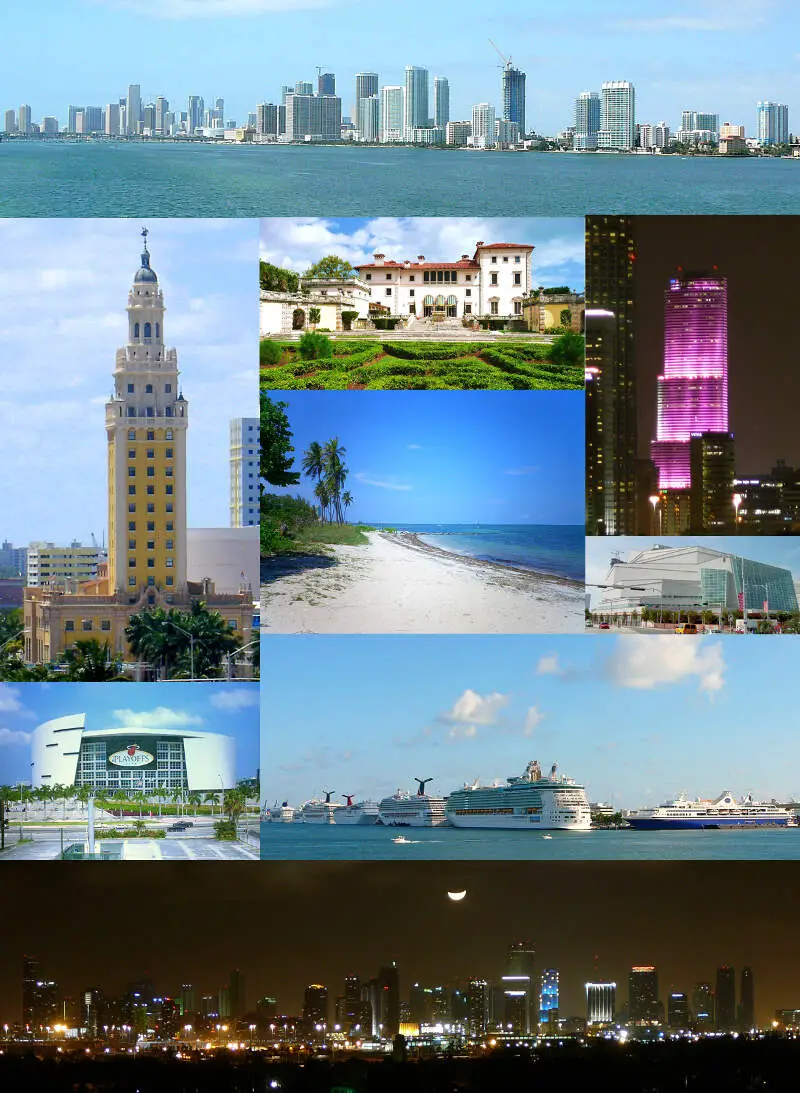
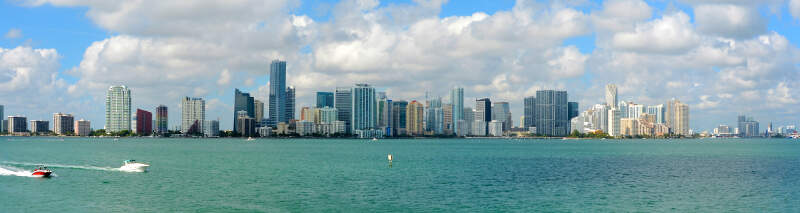

Cost of living
Miami is the cheaper city overall — 34% higher in San Diego than its rival. Index baseline: 100 = national average.
| Living expense | San Diego | Miami | US average |
|---|---|---|---|
| Overall | 175 | 131 | 100 |
| Services | 121 | 106 | 100 |
| Groceries | 121 | 110 | 100 |
| Health | 296 | 169 | 100 |
| Housing | 127 | 108 | 100 |
| Transportation | 131 | 121 | 100 |
| Utilities | 135 | 120 | 100 |
Lower index = cheaper. 100 = U.S. national average. Bar inside each cell scales relative to the highest value in the table.
Sources: HomeSnacks Cost of Living indices, normalized so 100 = U.S. national average. Drill in: San Diego cost of living, Miami cost of living, or the cheapest cities in America.
Housing breakdown
Home prices are higher in Miami. Compare absolute price and price-to-income — a $500k home in a $100k-income city is very different from one in a $50k-income city.
| Metric | San Diego | Miami | United States |
|---|---|---|---|
| Median Home Value | $1,001,264 | $579,563 | $332,700 |
| Median Rent | $2,313 | $1,758 | $1,413 |
| Median Income | $108,077 | $62,462 | $80,734 |
| Home Value To Income | 9.3x | 9.3x | 4.1x |
| Rent To Monthly Income | 0.26x | 0.34x | 0.21x |
Source: U.S. Census Bureau ACS 2020-2024. See also states with the highest rent in America.
Crime
San Diego is the safer city — total crime rate of 2,082 per 100k people vs 3,468 for Miami. US average: 2,119.
| Crime (per 100k) | San Diego | Miami | US average |
|---|---|---|---|
| Total crime | 2,082 | 3,468 | 2,119 |
| Murder | 3 | 6 | 5 |
| Robbery | 77 | 95 | 61 |
| Aggravated Assault | 311 | 348 | 256 |
| Violent Crime | 412 | 473 | 359 |
| Burglary | 187 | 294 | 229 |
| Larceny | 1,087 | 2,290 | 1,272 |
| Car Theft | 396 | 410 | 259 |
| Property Crime | 1,670 | 2,995 | 1,760 |
Lower = safer. Bar inside each cell scales relative to the highest crime rate in the table.
Source: FBI Uniform Crime Reporting (2024). All rates are per 100,000 people. City pages: San Diego crime, Miami crime. See also: safest cities in America.
Diversity
San Diego is more racially diverse — lower HHI (closer to 0) means a more even mix across groups.
| Group | San Diego | Miami | United States |
|---|---|---|---|
| White | 40.9% | 12.1% | 57.4% |
| African American | 5.3% | 11.9% | 11.9% |
| American Indian | 0.2% | 0.1% | 0.5% |
| Asian | 17.3% | 1.6% | 5.9% |
| Hawaiian | 0.4% | 0.0% | 0.2% |
| Other | 0.7% | 0.6% | 0.6% |
| Two Or More | 5.5% | 2.2% | 4.3% |
| Hispanic | 29.8% | 71.5% | 19.3% |
Source: U.S. Census ACS 2020-2024. Lower HHI = more even racial mix. See also: most diverse cities in America.
SnackAbility — overall quality of life
San Diego scores higher overall — 8/10 vs 5/10. SnackAbility is our 1–10 quality-of-life score; the median U.S. city scores a 7.
Scores are 0–10; both bars share the same scale.
SnackAbility is a HomeSnacks proprietary 1–10 score blending jobs, housing, education, commute, amenities, affordability, crime, and diversity. Median U.S. city ≈ 7. Data: Census, BLS, FBI. See also: best places to live in America.
Getting around: San Diego vs. Miami
How each city handles commuting, transit, walkability, and car culture — the day-to-day reality that shapes where you'd actually want to live.
San Diego runs on the Metropolitan Transit System (MTS), which covers three trolley lines and an extensive bus network, but the city's sprawling layout means most residents drive. Neighborhoods like Chula Vista, El Cajon, and Mira Mesa are practically inaccessible without a car, and rush-hour congestion on I-5 and I-8 is a real consideration. Biking is increasingly viable along the coast, particularly in Pacific Beach and Mission Bay.
Miami has the Metrorail, the automated Metromover loop downtown, and Metrobus, but like San Diego it stays deeply car-centric. Traffic on I-95 and the Palmetto Expressway can be punishing, especially in peak snowbird season. One advantage Miami has is walkability in dense cores like Brickell, Wynwood, and South Beach, where rideshare and scooters genuinely replace a car for daily errands.
Jobs and careers in San Diego vs. Miami
The local job market, dominant industries, and which city to choose based on your career.
San Diego's job market skews toward high-paying industries, which helps explain the median household income of $108,077. Defense and military contracting anchors the economy, with NAVWAR and the Naval Base San Diego among the largest employers, alongside a biotech and life sciences cluster centered around Torrey Pines and Sorrento Valley. Major names like Qualcomm, Illumina, and UC San Diego Health provide stability across tech, semiconductors, and healthcare.
Miami's median household income of $62,462 reflects a different mix. The city is the financial and trade gateway to Latin America, with strong banking, international business, and real estate sectors concentrated in Brickell. Tourism and hospitality remain massive employers, though wages in those industries pull the median down.
If your career is in finance, logistics, or multilingual international business, Miami offers genuine competitive advantages San Diego simply doesn't match.
Weather and climate
What to expect day-to-day — sun, fog, heat, rain, and the seasonal extremes that shape the lifestyle.
San Diego's Mediterranean climate is consistently mild, which is a big part of why people move here. Summers top out around the low 80s with low humidity, winters rarely dip below 50°F, and annual rainfall is minimal. The one caveat is "June Gloom" — a marine layer that blankets coastal neighborhoods most mornings from May through early July, which can feel dreary if you moved there expecting sun.
Miami runs on a subtropical calendar with two distinct seasons. Winters (December through April) are genuinely pleasant, with highs in the low 70s and low humidity — peak season for a reason. Summers are relentlessly hot and humid, with daily afternoon thunderstorms from June through September and real hurricane risk through November.
If heat and storm prep are dealbreakers, San Diego's climate is significantly more forgiving year-round.
Culture, nightlife, and entertainment
Food, music, neighborhoods, and the city vibe that gives each place its personality.
San Diego's cultural identity is laid-back and eclectic. The Gaslamp Quarter anchors downtown nightlife, while North Park and South Park have become the main hubs for independent bars, craft cocktail spots, and live music venues. San Diego's craft beer culture is nationally recognized — breweries like Stone, Societe, and Modern Times are part of everyday social life here.
Little Italy has a walkable restaurant strip. Balboa Park houses 17 museums, including the San Diego Museum of Art.
Miami's culture hits at a different frequency — louder, more international, and more night-forward. Wynwood draws a global arts crowd with its murals and gallery scene, Little Havana offers Cuban culture you won't find anywhere else in the country, and South Beach's club scene (LIV, E11EVEN) runs well past 4 a.m. The city's Latin American influence permeates its food, music, and calendar of festivals in a way that makes San Diego feel comparatively muted.
Outdoor activities and day trips
Parks, beaches, hikes, and the weekend escapes that define life outside the city limits.
San Diego gives outdoor enthusiasts a lot of range without much driving. Torrey Pines State Reserve sits just north of La Jolla with clifftop trails over the Pacific, and Mission Trails Regional Park has rugged hiking minutes from the suburbs. Surfers spread across Pacific Beach, Ocean Beach, and Sunset Cliffs.
Day trips reach Julian in the mountains, Anza-Borrego Desert State Park, and the Channel Islands ferry from Oceanside. With a total crime rate of 2,082 per 100k, trails and parks generally feel safe and well-maintained.
Miami's outdoors centers on water. Biscayne Bay is the front yard for kayaking, paddleboarding, and sailing, and Key Biscayne's Bill Baggs State Park offers a quieter beach escape from South Beach's crowds. The Everglades are about an hour west — airboat tours and wildlife watching that no San Diego day trip can replicate.
Miami's summer heat and humidity can make midday outdoor activity genuinely unpleasant from June through September, while San Diego's temperate air keeps trails and beaches accessible year-round.
Bottom line: which city is right for you?
Based on the head-to-head data above, here's the short version — pick the city that lines up with what you actually care about.
Choose San Diego if you prioritize…
- lower crime — a safer place to live, work, and raise a family.
- a more racially diverse community (lower HHI on Census data).
- a higher overall SnackAbility quality-of-life score.
Choose Miami if you prioritize…
- a lower cost of living (cheaper groceries, services, and day-to-day expenses).
- more affordable housing relative to San Diego.
Methodology: winners are picked from public data — U.S. Census Bureau ACS (income, home value, rent, race/HHI), FBI Uniform Crime Reporting (crime rates per 100k), and HomeSnacks' proprietary SnackAbility quality-of-life score, which blends Bureau of Labor Statistics data with the above.
Other comparisons
Still weighing your options? See how these two cities stack up against other places we've compared head-to-head.