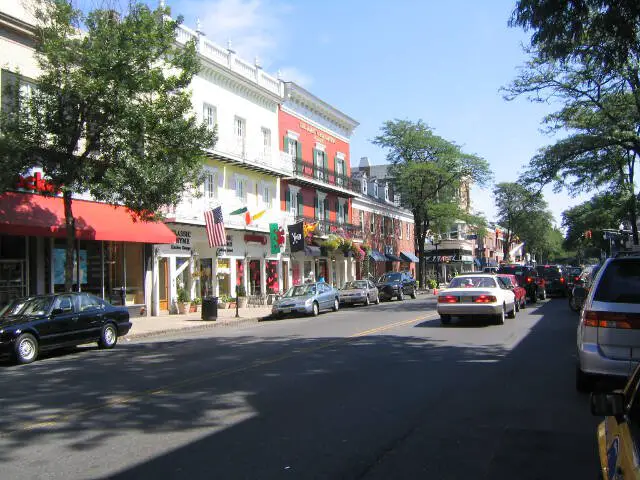
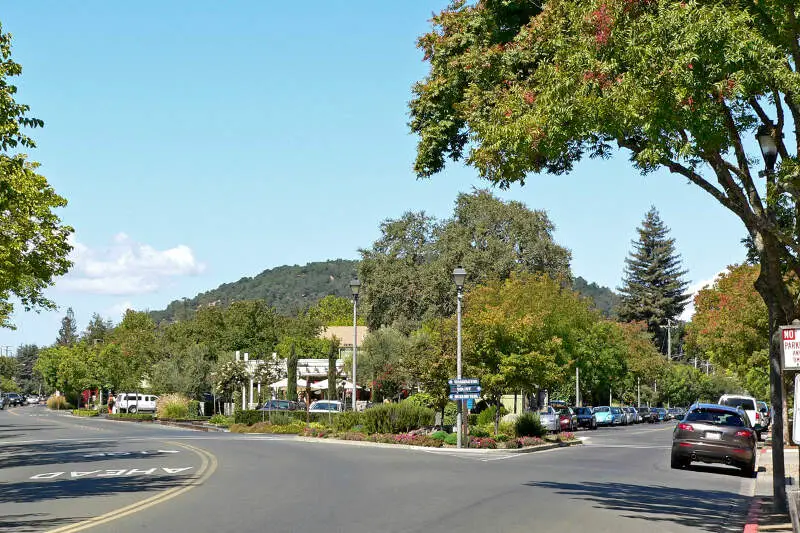
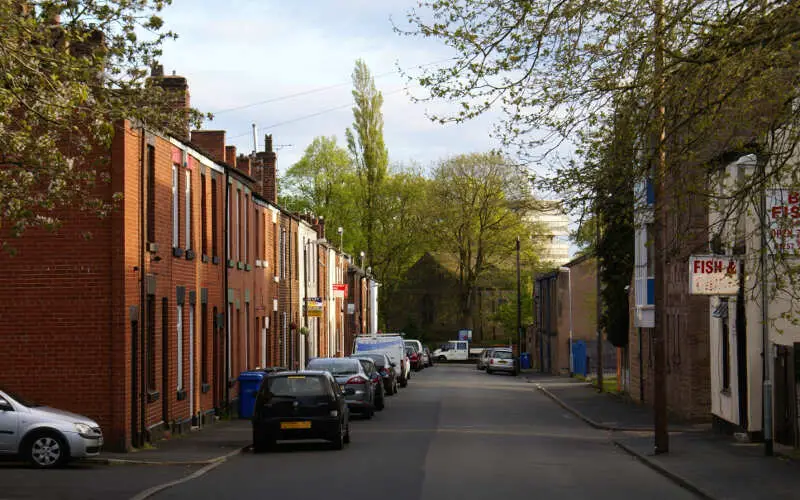
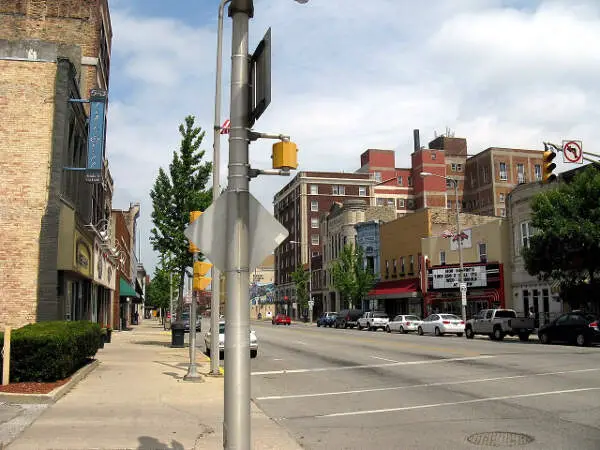
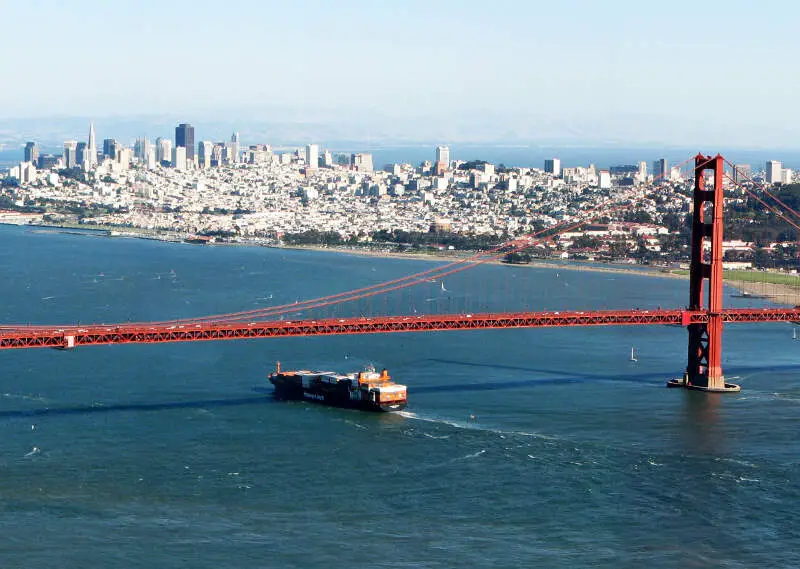
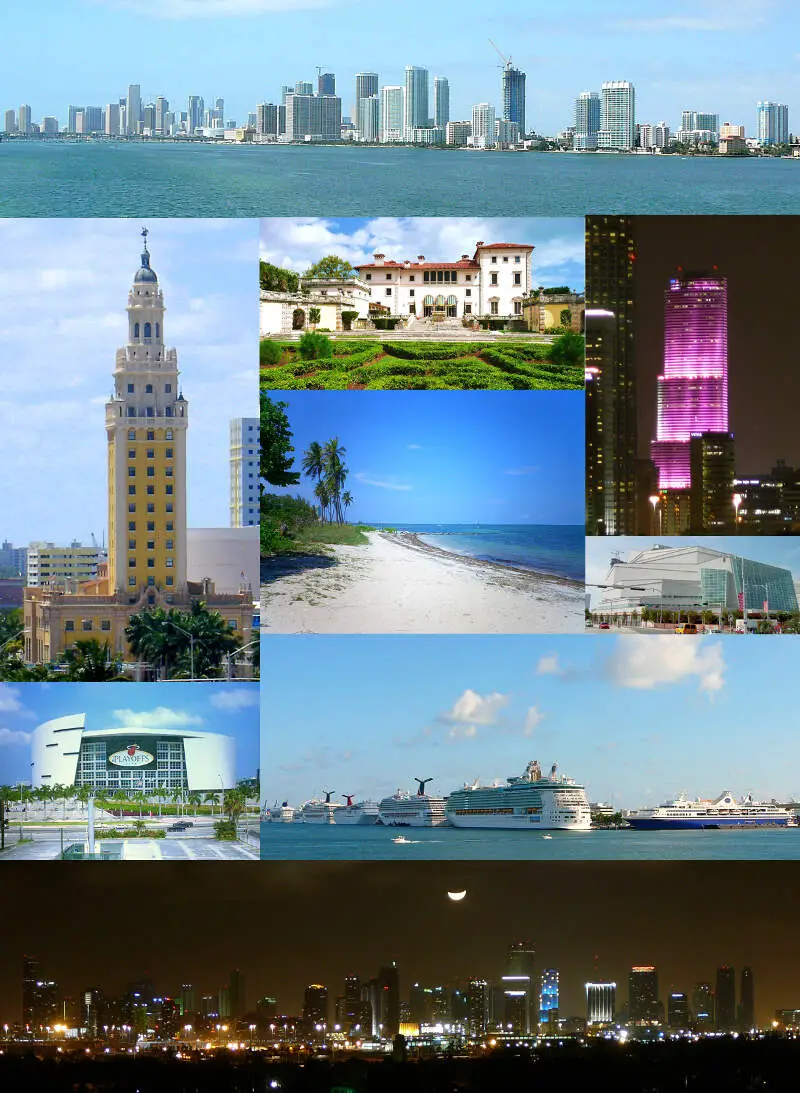
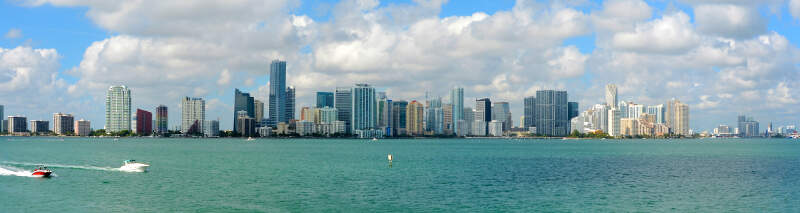
San Francisco vs. Miami in photos
A side-by-side look at each city.



Cost of living
Miami is the cheaper city overall — 89% higher in San Francisco than its rival. Index baseline: 100 = national average.
| Living expense | San Francisco | Miami | US average |
|---|---|---|---|
| Overall | 247 | 131 | 100 |
| Services | 122 | 106 | 100 |
| Groceries | 125 | 110 | 100 |
| Health | 518 | 169 | 100 |
| Housing | 132 | 108 | 100 |
| Transportation | 128 | 121 | 100 |
| Utilities | 139 | 120 | 100 |
Lower index = cheaper. 100 = U.S. national average. Bar inside each cell scales relative to the highest value in the table.
Sources: HomeSnacks Cost of Living indices, normalized so 100 = U.S. national average. Drill in: San Francisco cost of living, Miami cost of living, or the cheapest cities in America.
Housing breakdown
Home prices are higher in Miami. Compare absolute price and price-to-income — a $500k home in a $100k-income city is very different from one in a $50k-income city.
| Metric | San Francisco | Miami | United States |
|---|---|---|---|
| Median Home Value | $1,356,661 | $579,563 | $332,700 |
| Median Rent | $2,476 | $1,758 | $1,413 |
| Median Income | $140,970 | $62,462 | $80,734 |
| Home Value To Income | 9.6x | 9.3x | 4.1x |
| Rent To Monthly Income | 0.21x | 0.34x | 0.21x |
Source: U.S. Census Bureau ACS 2020-2024. See also states with the highest rent in America.
Crime
Miami is the safer city — total crime rate of 3,468 per 100k people vs 4,526 for San Francisco. US average: 2,119.
| Crime (per 100k) | San Francisco | Miami | US average |
|---|---|---|---|
| Total crime | 4,526 | 3,468 | 2,119 |
| Murder | 4 | 6 | 5 |
| Robbery | 267 | 95 | 61 |
| Aggravated Assault | 290 | 348 | 256 |
| Violent Crime | 596 | 473 | 359 |
| Burglary | 637 | 294 | 229 |
| Larceny | 2,619 | 2,290 | 1,272 |
| Car Theft | 673 | 410 | 259 |
| Property Crime | 3,929 | 2,995 | 1,760 |
Lower = safer. Bar inside each cell scales relative to the highest crime rate in the table.
Source: FBI Uniform Crime Reporting (2024). All rates are per 100,000 people. City pages: San Francisco crime, Miami crime. See also: safest cities in America.
Diversity
San Francisco is more racially diverse — lower HHI (closer to 0) means a more even mix across groups.
| Group | San Francisco | Miami | United States |
|---|---|---|---|
| White | 36.8% | 12.1% | 57.4% |
| African American | 4.7% | 11.9% | 11.9% |
| American Indian | 0.2% | 0.1% | 0.5% |
| Asian | 34.9% | 1.6% | 5.9% |
| Hawaiian | 0.3% | 0.0% | 0.2% |
| Other | 0.8% | 0.6% | 0.6% |
| Two Or More | 6.1% | 2.2% | 4.3% |
| Hispanic | 16.2% | 71.5% | 19.3% |
Source: U.S. Census ACS 2020-2024. Lower HHI = more even racial mix. See also: most diverse cities in America.
SnackAbility — overall quality of life
San Francisco scores higher overall — 8.5/10 vs 5/10. SnackAbility is our 1–10 quality-of-life score; the median U.S. city scores a 7.
Scores are 0–10; both bars share the same scale.
SnackAbility is a HomeSnacks proprietary 1–10 score blending jobs, housing, education, commute, amenities, affordability, crime, and diversity. Median U.S. city ≈ 7. Data: Census, BLS, FBI. See also: best places to live in America.
Getting around: San Francisco vs. Miami
How each city handles commuting, transit, walkability, and car culture — the day-to-day reality that shapes where you'd actually want to live.
San Francisco gives you genuine options beyond a car. BART connects the city to Oakland, Berkeley, and the airport, while Muni buses and light rail cover most neighborhoods. Caltrain runs south toward Silicon Valley for tech commuters.
The Mission, SoMa, and the Financial District are walkable and bike-lane dense. Driving in SF, though, means steep hills, scarce parking, and chronic congestion on the Bay Bridge and Highway 101.
Miami runs almost entirely on cars. The Metrorail and Metromover serve downtown Brickell and a corridor heading south, but most of the metro area (Wynwood, Coral Gables, Doral, the Beaches) demands a vehicle. I-95 and the Palmetto Expressway clog reliably during rush hour.
If you're relocating from a transit-first city, Miami's car dependence is one of the biggest lifestyle adjustments you'll face.
Jobs and careers in San Francisco vs. Miami
The local job market, dominant industries, and which city to choose based on your career.
San Francisco sits at the center of the global tech economy. Salesforce, Twitter/X, Uber, Lyft, Stripe, and dozens of venture-backed startups are headquartered here or maintain major offices, and the Peninsula corridor stretches to Apple, Google, and Meta.
That concentration of high-paying roles drives a median household income of $140,970, more than double Miami's $62,462. Finance and healthcare round out the local economy, but tech sets the salary ceiling.
Miami has evolved well beyond tourism and hospitality. Brickell is now a legitimate financial hub, and fintech, crypto, and remote-first companies have been relocating here over the past few years, drawn by Florida's lack of state income tax.
Latin American trade and banking bring stable white-collar work, and the healthcare sector (anchored by Jackson Health System and Baptist Health) is a major employer. Salaries run lower, but so does the tax burden.
Weather and climate
What to expect day-to-day — sun, fog, heat, rain, and the seasonal extremes that shape the lifestyle.
San Francisco's climate is famously mild and famously misty. Summers rarely push above the mid-60s°F, and Karl the Fog rolls in off the bay to keep neighborhoods like the Sunset and Richmond genuinely cool in July. Winters are wet but not brutal: expect rain from November through March, with temperatures seldom dipping below 45°F.
The micro-climate variation is real. A sunny afternoon in the Mission can coincide with a foggy chill in the Outer Sunset just two miles away.
Miami has a true tropical climate that San Francisco can't match for sunshine or heat. Winters are warm and dry: a February afternoon in South Beach can hit the low 80s, which draws plenty of people escaping northern winters.
Summer is a different story. June through September brings serious heat, high humidity, daily afternoon thunderstorms, and a hurricane season that demands preparation and, occasionally, evacuation decisions.
Culture, nightlife, and entertainment
Food, music, neighborhoods, and the city vibe that gives each place its personality.
San Francisco fits a lot of cultural history into 47 square miles. The Castro has been a center of LGBTQ+ life for decades; Haight-Ashbury still carries its counterculture identity; North Beach is the old literary and Italian neighborhood; and the Mission blends Latin murals, taquerias, and some of the city's best bars.
The arts scene is serious. SFMOMA, the de Young, and the Symphony are world-class, and the restaurant scene stretches from Michelin-starred tasting menus to cult-status dim sum in the Richmond.
Miami's culture is loud, colorful, and heavily Latin. Wynwood's warehouse district is one of the country's best open-air street art destinations, and Little Havana along Calle Ocho is a living, eating, dancing neighborhood rather than a tourist set piece.
South Beach's nightlife is genuinely world-class. LIV, Story, and the clubs along Ocean Drive draw international DJs year-round, and Art Basel each December turns the city into a global art-world gathering point.
Outdoor activities and day trips
Parks, beaches, hikes, and the weekend escapes that define life outside the city limits.
San Francisco puts you within easy reach of some of the best outdoor recreation in the country. Golden Gate Park has 1,000 acres of trails, lakes, and gardens, and the Presidio sits at the water with sweeping bay views. Cross the bridge and you're in the Marin Headlands within 20 minutes; Muir Woods and Mount Tamalpais are under an hour away.
Lake Tahoe for skiing or hiking is a 3.5-hour drive, and Napa Valley is closer still. Year-round mild temperatures mean you can actually use all of it.
Miami's outdoors is defined by water. The Atlantic beaches (from South Beach north through Sunny Isles) are consistently beautiful, and Biscayne National Park, almost entirely underwater, makes for exceptional snorkeling and kayaking. The Everglades are an hour's drive west and have airboat tours, hiking, and wildlife with no equivalent anywhere in the lower 48.
Key West is an easy day trip south. If you're a surfer or skier, though, Miami leaves you flat: the waves are small and the mountains are nonexistent.
Bottom line: which city is right for you?
Based on the head-to-head data above, here's the short version — pick the city that lines up with what you actually care about.
Choose San Francisco if you prioritize…
- a more racially diverse community (lower HHI on Census data).
- a higher overall SnackAbility quality-of-life score.
Choose Miami if you prioritize…
- a lower cost of living (cheaper groceries, services, and day-to-day expenses).
- lower crime — a safer place to live, work, and raise a family.
- more affordable housing relative to San Francisco.
Methodology: winners are picked from public data — U.S. Census Bureau ACS (income, home value, rent, race/HHI), FBI Uniform Crime Reporting (crime rates per 100k), and HomeSnacks' proprietary SnackAbility quality-of-life score, which blends Bureau of Labor Statistics data with the above.
Other comparisons
Still weighing your options? See how these two cities stack up against other places we've compared head-to-head.